- Call Us Anytime
- 01719276403
- Opening Time
- 12 hours
- Email Us Now
- nandanickbd111@yahoo.com
Latest News
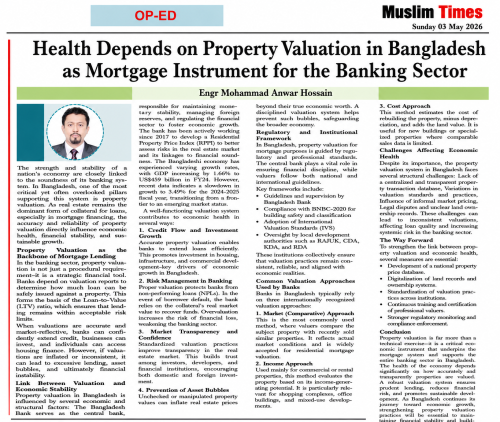
Health Depends on Property Valuation in Bangladesh as Mortgage Instrument for the Banking Sector.
The strength and stability of a nation's economy are closely linked to the soundness of its banking system. In Bangladesh, one of the most critical yet often overlooked pillars supporting this system is property valuation. As real estate remains the dominant form of collateral for loans, especially in mortgage financing, the accuracy and reliability of property valuation directly influence economic health, financial stability, and sustainable growth.
Property Valuation as the Backbone of Mortgage Lending
In the banking sector, property valuation is not just a procedural requirement—it is a strategic financial tool. Banks depend on valuation reports to determine how much loan can be safely issued against a property. This forms the basis of the Loan-to-Value (LTV) ratio, which ensures that lending remains within acceptable risk limits.
When valuations are accurate and market-reflective, banks can confidently extend credit, businesses can invest, and individuals can access housing finance. However, if valuations are inflated or inconsistent, it can lead to excessive lending, asset bubbles, and ultimately financial instability.
Link Between Valuation and Economic Stability
Property valuation in Bangladesh is influenced by several economic and structural factors. The Bangladesh Bank serves as the central bank, responsible for maintaining monetary stability, managing foreign reserves, and regulating the financial sector to foster economic growth. The bank has been actively working since 2017 to develop a Residential Property Price Index (RPPI) to better assess risks in the real estate market and its linkages to financial soundness.
The Bangladeshi economy has experienced varying growth rates, with GDP increasing by 1.66% to US$459 billion in FY24. However, recent data indicates a slowdown in growth to 3.49% for the 2024–2025 fiscal year, transitioning from a frontier to an emerging market status.
A well-functioning valuation system contributes to economic health in several ways:
1. Credit Flow and Investment Growth
Accurate property valuation enables banks to extend loans efficiently. This promotes investment in housing, infrastructure, and commercial development—key drivers of economic growth in Bangladesh.
2. Risk Management in Banking
Proper valuation protects banks from non-performing loans (NPLs). In the event of borrower default, the bank relies on the collateral's real market value to recover funds. Overvaluation increases the risk of financial loss, weakening the banking sector.
3. Market Transparency and Confidence
Standardized valuation practices improve transparency in the real estate market. This builds trust among investors, developers, and financial institutions, encouraging both domestic and foreign investment.
4. Prevention of Asset Bubbles
Unchecked or manipulated property values can inflate real estate prices beyond their true economic worth. A disciplined valuation system helps prevent such bubbles, safeguarding the broader economy.
Regulatory and Institutional Framework
In Bangladesh, property valuation for mortgage purposes is guided by regulatory and professional standards. The central bank plays a vital role in ensuring financial discipline, while valuers follow both national and international guidelines.
Key frameworks include:
- Guidelines and supervision by Bangladesh Bank.
- Compliance with BNBC-2020 for building safety and classification.
- Adoption of International Valuation Standards (IVS).
- Oversight by local development authorities such as RAJUK, CDA, KDA, and RDA.
These institutions collectively ensure that valuation practices remain consistent, reliable, and aligned with economic realities.
Common Valuation Approaches Used by Banks
Banks in Bangladesh typically rely on three internationally recognized valuation approaches:
1. Market (Comparative) Approach
This is the most commonly used method, where valuers compare the subject property with recently sold similar properties. It reflects actual market conditions and is widely accepted for residential mortgage valuation.
2. Income Approach
Used mainly for commercial or rental properties, this method evaluates the property based on its income-generating potential. It is particularly relevant for shopping complexes, office buildings, and mixed-use developments.
3. Cost Approach
This method estimates the cost of rebuilding the property, minus depreciation, and adds the land value. It is useful for new buildings or specialized properties where comparable sales data is limited.
Challenges Affecting Economic Health
Despite its importance, the property valuation system in Bangladesh faces several structural challenges:
- Lack of a centralized and transparent property transaction database.
- Variations in valuation standards and practices.
- Influence of informal market pricing.
- Legal disputes and unclear land ownership records.
These challenges can lead to inconsistent valuations, affecting loan quality and increasing systemic risk in the banking sector.
The Way Forward
To strengthen the link between property valuation and economic health, several measures are essential:
- Development of a national property price database.
- Digitization of land records and ownership systems.
- Standardization of valuation practices across institutions.
- Continuous training and certification of professional valuers.
- Stronger regulatory monitoring and compliance enforcement.
Conclusion
Property valuation is far more than a technical exercise—it is a critical economic instrument that underpins the mortgage system and supports the entire banking sector in Bangladesh. The health of the economy depends significantly on how accurately and transparently properties are valued. A robust valuation system ensures prudent lending, reduces financial risk, and promotes sustainable development. As Bangladesh continues its journey toward economic growth, strengthening property valuation practices will be essential to maintaining financial stability and building long-term investor confidence.
Ref- Muslim Times(Sunday 03 May 2026)